


August Reporting Season: A Two-Speed Market with Clear Winners and Pressure Points
Summary of key themes and company insights from the August 2026 Australian reporting season
Summary
- Headline earnings were stronger but narrow in composition. Aggregate market earnings growth of ~10% was supported largely by resources, while ex-resources growth was more modest at ~5%.
- Guidance mattered more than reported profit. Companies that produced reasonable FY26 results were still marked down where FY27 trading updates pointed to softer volumes, rising costs or weaker consumer demand.
- Healthcare and resources led the recovery. Healthcare benefited from a sharp rebound in CSL and broader reassessment of the sector, while miners were supported by commodity prices, balance sheet strength and dividends.
- Banks shifted from earnings support to earnings risk. Credit growth remained solid, margins were stable and bad debts low, but investors focused on the prospect of slowing loan growth, rising arrears and limited capital flexibility in the backdrop of higher interest rates and Budget changes.
- Cost inflation remains entrenched. Labour, procurement and funding costs were recurring pressure points, making pricing power and productivity initiatives critical to protecting margins.
- Capital management was a major feature. Dividends generally surprised positively and additional buybacks of $7B was announced.
- AI was framed as an enabler, not a disruptor. Companies exposed to AI risk sought to demonstrate productivity benefits mainly – with less reference to revenue streams.
Reporting season overview
1. A stronger reporting season, but not a broad-based one
The season delivered a reasonable aggregate result with two-thirds of companies either met or beat expectations. Aggregate market earnings grew by roughly 10% in FY26. Resources drove a disproportionate share of market earnings growth, helped by commodity prices, production strength and strong cash generation. Ex-resources, the earnings picture was more subdued.
The market was prepared to look through backward-looking FY26 results only where companies could show a credible path to FY27 growth.
Investors rewarded companies with visible earnings, strong cash flow, pricing power and disciplined capital management. Conversely, companies with weaker FY27 commentary, uncertain volumes or rising cost pressure were treated harshly, even where the reported FY26 numbers were acceptable. Where guidance deteriorated, or where trading updates suggested slowing demand, share prices came under pressure.
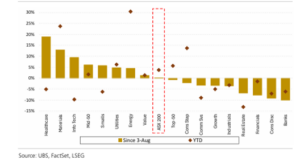
Chart 1: Australian Equity price performance through reporting season
2. Sector leadership rotated sharply
As shown in the chart above, Healthcare was the standout performer, with the sector helped by a sharp rebound in CSL’s share price and a broader recovery in previously de-rated healthcare exposures. Materials also performed well, supported by resilient commodity prices, stronger production, solid dividends and healthier balance sheets. Gold and diversified miners were particularly well supported by macro tailwinds, including US dollar weakness, central bank buying, and demand expectations linked to electrification and data centre investment.
3. Banks moved from support to drag on earnings
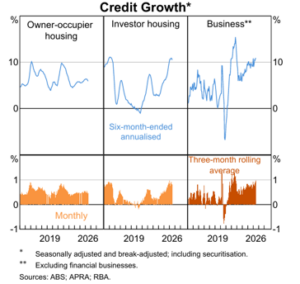
The Banks were a drag on the market during the period. Trading updates from the the Banks (only CBA reports annual results in August) showed business credit growth remaining strong but mortgage applications falling sharply following the Budget. Investors focused on signs that revenue momentum had peaked given the weakness in mortgage applications. There were little signs of stress but capital generation was becoming more constrained.
4. Consumer health became the key macro question
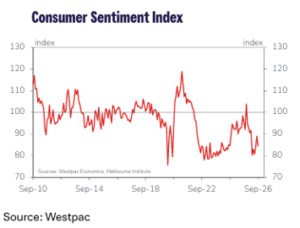
Reporting season reinforced that the consumer remains under pressure. Supermarkets and non-discretionary categories held up well with good trading results into August, but discretionary retail and housing-linked exposures showed weaker momentum. Several retailers cited softer trading in July and August, while consumer sentiment indicators and higher rates remained important headwinds.
Housing-linked categories were weaker, reflecting rate pressure, affordability constraints and caution around the property cycle.
5. AI emerged as both a cost and productivity theme
AI was a notable thematic across the season. For online, technology and data-centric businesses, the focus was on operating leverage, engineering productivity and the ability to embed AI into workflows. At the macro level, data centre and technology-related investment also remained a source of demand for infrastructure service providers (electrical contractors), energy and selected commodities.
The response from the market this reporting season was different. Fears around AI and a Saaspocalypse appeared to shift. Several companies described tangible productivity initiatives, including automation, engineering efficiency and workflow improvement. For companies perceived to be exposed to AI disruption, the key message was that AI could complement their existing platforms rather than erode pricing power or barriers to entry.
6. Dividends and buybacks carried weight
Capital management was one of the most supportive features of the season. Dividends generally beat expectations and companies with surplus capital used buybacks (announcements totalling ~$7b) to reinforce confidence in balance sheet strength. This mattered in a market where investors were increasingly focused on income, cash conversion and capital discipline.
7. Cost inflation remains embedded
Inflation was no longer presented as a temporary issue. Fair Work related wage increases were being embedded into operating assumptions, making productivity and pricing power central to the FY27 outlook for operating margins. Companies with strong brands, market positions or contractual pass-through mechanisms were better placed to protect margins.
Individual stock observations of key positions
CSL
CSL’s share price reaction was one of the defining stock stories of the reporting season. The response was on the back of improving trends in the core plasma business and greater confidence that restructuring actions are beginning to deliver. CSL Behring is expected to return to mid-single-digit sales growth and improving margins through FY27, supporting a path back toward high-single-digit earnings growth in FY28.
The incoming CEO inherits a business in better shape than it was 12 months ago. The separation of Seqirus provides additional strategic flexibility, while the restructuring of the plasma operations improves the group’s ability to rebuild earnings momentum. Vifor remains the key drag, with management guiding to a material revenue decline as generic competition and product withdrawals weigh on the division. Over time, however, the Vifor contribution is expected to shrink as a share of group earnings, reducing its impact on the investment case.
Forecast revisions were affected by the shift from NPATA to NPAT guidance and higher amortisation, but the underlying direction of travel improved. The proposed $1.1b buyback will deliver additional EPS accretion. Valuation support increased as the path back to sustainable growth became clearer.
REA Group
REA delivered broadly in-line FY26 results and an FY27 outlook that was better than feared, but listing volumes remain the key uncertainty. July volumes were down around 2% yoy and August appeared to be running at a similar rate, creating a better start to FY27 than expected. However, the market remains cautious given soft housing indicators, agent feedback that listings activity is slowing, and uncertainty around property tax changes.
Despite the weaker volume outlook, REA continues to execute well on costs. Management’s use of AI tools to improve engineering productivity points to potential upside in operating leverage. Yield growth remains supportive, although there is risk from geographic mix and softer agent appetite for premium products in a weaker market.
James Hardie
James Hardie (JHX) continues to execute well despite a subdued US housing backdrop. Recent earnings and upgraded FY27 guidance highlight ongoing market share gains in fibre cement siding, benefiting from the exit of competitor Nichiha, while the newly consolidated decking business is also seeing early momentum following distributor realignment initiatives. Importantly, management’s updated guidance implies little change to expectations for the second half of FY27, reflecting a deliberately conservative stance given ongoing channel adjustments and macroeconomic uncertainty. We view this prudence positively, particularly as the company is not assuming any recovery in US housing activity or improvement in consumer confidence. The company divested its European business for Euro840m – this will substantially remediate the balance sheet, bringing forward additional returns to shareholders through buybacks.
From a longer-term perspective, our investment thesis remains unchanged. James Hardie holds a dominant position in fibre cement siding, a category that continues to take share from alternative building materials, while the acquisition of AZEK provides exposure to the structural growth of composite decking. We believe James Hardie’s scale, brand strength and distribution capabilities can accelerate market share gains in decking over time, particularly as the industry consolidates around leading players. While mortgage rates and housing turnover remain near-term headwinds, we continue to see significant upside from an eventual US housing recovery, ongoing Repair & Remodel demand, operational self-help opportunities within AZEK, and the company’s ability to extend its leadership in attractive categories. Recent trading trends suggest the business is tracking toward the upper end of expectations, reinforcing our confidence in the medium-term earnings outlook.
Cochlear
After downgrading their earnings expectations in April, Cochlear achieved the top end of the revised guidance. Implant sales at ~6% was at the top end of their 2-6% guidance. Within that, Developed markets growth at 1% was at the lower end of expectations. FY27 guidance for NPAT of $330-350m was within the expected range and the share price movement was muted, having recovered 40% from the lows post the last downgrade. We expect Cochlear to continue to improve their operational cadence across its key markets as the new Nexa implant takes share and delivery of its FY27 results will improve investor confidence in the management’s ability to execute.
Outlook for FY27
The outlook was softer compared to prior periods. Market earnings growth expectations have been reduced to around 5% EPS growth, with management teams generally more cautious on volumes, margins and consumer demand. Outlook statements were more downbeat in certain sectors, such as banks, discretionary retail and housing-linked businesses.
The key macro variables are the health of the consumer, the RBA rate path and the labour market. Consumer sentiment has softened, and the market is increasingly sensitive to evidence that higher rates and cost-of-living pressure are flowing through to company revenue and margins. A higher Australian dollar also creates dispersion, pressuring international earners while supporting some domestic retailers through lower landed costs. Against that, consumers are still spending and unemployment remains low which provides support.
Resources remain well supported, with commodity prices, gold demand and AI-related infrastructure investment providing a buffer against domestic weakness. However, longer-term supply growth, particularly in iron ore, remains a risk.
In the context of a tougher domestic operating environment, we believe that the portfolio is well positioned – defensive companies such as Sigma, Ramsay Healthcare, Woolworths and Wesfarmers should outperform. We have a larger exposure to the strong US economy, with stocks like Macquarie, James Hardie, Aristocrat and Light and Wonder expected to do well. Being underweight banks should be a tailwind for portfolio performance. Our resources exposure in the diversified miners BHP, Rio and copper producer Sandfire should be supported, given global growth is still strong.